Load cells (force sensors)
ITLL load cell inventory
Bridge-Based Sensors
Pulled straight from NI-DAQmx Help; this is an explanation of howHow bridge-based load cells work:work (Source: Pulled straight from NI-MAX):
Bridge-based sensors operate by correlating a physical phenomena, such as strain, temperature, or force, to a change in resistance in one or more legs of a Wheatstone bridge. The general Wheatstone bridge, shown in the following figure, is a network of four resistive legs with an excitation voltage, VEX, that is applied across the bridge. One or more of these legs can be active sensing elements.

A physical phenomena, such as a temperature shift or a change in strain applied to a specimen, changes the resistance of the sensing elements in the Wheatstone bridge. You can use the Wheatstone bridge configuration to help measure the small variations in resistance that the sensing elements produce corresponding to a physical change in the specimen.
Using an NI-9237 DAQ to read force data
You will need:
- load cell
- NI breakout (RJ-50 [looks like an ethernet but has 10, not 8 pins] to screw terminal)
- RJ-50 cable (see note above about resemblance to ethernet cable)
- NI-9237
- NI
DAQcDAQ-9171 - Computer with LabVIEW/NI MAX
- USB A- USB B cable to interface with cDAQ


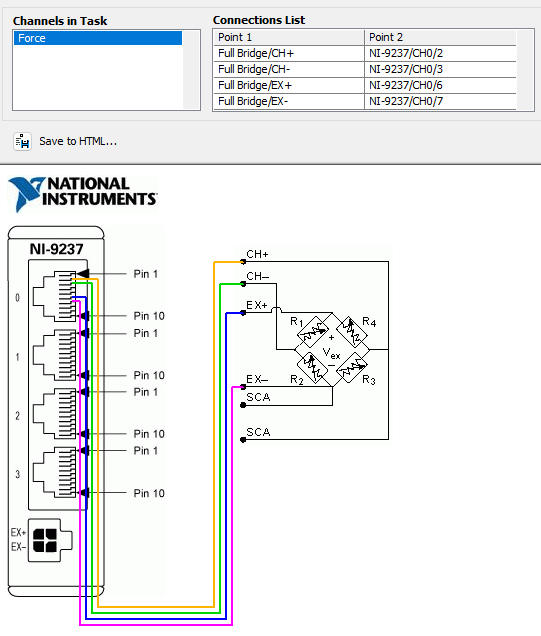
This is the connection diagram: