ECEE Cadence Server
- Web Browser Connection Guide (start here!)
- Windows TigerVNC Connection Guide
- MacOS TigerVNC Connection Guide
- Linux TigerVNC Connection Guide
- Starting Cadence Virtuoso
Web Browser Connection Guide (start here!)
Introduction
Access to the Cadence server gives you your own Linux desktop that lives in our data center instead of on your computer. You reach it right from your web browser, there's nothing to install, and your session keeps running after you disconnect! Start a design verification check, close the tab, reconnect from somewhere else, and it's still there exactly the way you left it.
This guide walks through accessing the server from start to finish and provides troubleshooting tips for common issues. There's no SSH tunnel to open and no port number to look up. Instead, your connection to the server is encrypted over HTTPS.
Connecting from your web browser is the simplest way to reach your remote desktop, and in a full screen browser tab you'll likely find it performs plenty well. For most people, it is recommended to start with this method. But if you'd like a more fully featured remote desktop experience, installing the TigerVNC client on your computer may be worth the extra setup (see our guides for Windows, macOS, and Linux). It can send all keyboard shortcuts to the remote desktop instead of your browser, go full screen across multiple monitors, better copy/paste clipboard, and renders the display a little faster, which you could notice when working in larger layout files.
Before you start
- You need access to the server. If you are looking to get access, email itlpithelp@colorado.edu. Include information such as the ECEN Course # you are taking that will be using the Cadence Tools. Researchers – please let us know which research lab you are affiliated with.
- You need to be on the campus network, either connected to CU Secure WiFi or connected to the CU VPN.
- You'll use your identikey username and password – the same credentials you use for other services on campus, there's no separate account for this server.
- You need a current web browser. Chrome, Edge, Firefox, and Safari all work.
1. Go to the Cadence server
Every person on the server gets their own desktop, so the first page just asks who you are. Open your web browser and go to:
https://ecee-cadence.int.colorado.edu
Type your identikey and click Connect to my desktop. Only your identikey here, no password, no email.

The landing page. It only needs your username so it knows which desktop URL is yours.
Why does it ask for my identikey twice? This first page doesn't log you in. It only redirects you to your own desktop's address. The next page is the one that handles authentication with your username and password. If you already bookmarked the URL of your remote desktop, you don't have to start here.
2. Sign in

Enter your identikey username and password and click Send Credentials.
Bookmark this page. Check the address bar. That link is yours and always takes you straight to your own desktop, so if you save it as a bookmark, you can skip step 1 entirely.
Just got access? The server sets up your desktop within about half an hour of your access being approved. If you get "Authentication failed" right away and you're sure of your password, give it a little while and try again. If it still doesn't work after an hour, email itlpithelp@colorado.edu.
3. You're in!

Your desktop on the Cadence server, running in a browser tab.
This is Xfce, a lightweight Linux desktop. The Applications menu is in the top left corner, and there's a dock along the bottom with a terminal, a file manager, and a web browser. Your home directory on the server is yours and it persists i.e. files you leave there will be there next time. But please save a copy of important files in your OneDrive, profiles may be wiped between semesters. You can open the web browser in your Linux desktop and browse to www.onedrive.com for uploads / downloads to your personal cloud storage.
The small tab on the left edge of the window opens the noVNC control bar. That's where you'll find full screen, the clipboard, settings, and disconnect.
A note on keys and copy/paste. Some keyboard shortcuts belong to your browser, not the remote desktop. Ctrl-W in particular closes the browser tab instead of a window in the linux desktop. Nothing is lost if that happens, your session keeps running, just open your bookmark again. Full screen mode helps. If copy and paste between your computer and the remote desktop doesn't work directly, use the Clipboard panel in the control bar: paste your text into the box there, then paste it inside the remote desktop.
Mac users: inside the remote desktop it's Ctrl-C / Ctrl-V, not ⌘-C / ⌘-V.
Closing vs. Logging out
It's good to know the difference between closing your browser tab and logging out of your desktop.
| What you do | What happens |
|---|---|
| Close the browser tab (or the whole browser) | Your session keeps running on the server. Applications stay open, design verifications keep going, and when you reconnect later everything is exactly where you left it. |
| Log Out from the Applications menu | Your session ends and everything running in it is closed. You can log back in, but you get a fresh desktop - whatever you had open does not come back. If you know you are done working, please choose this option, so that your session doesn't continue to consume resources on the server. |
Coming back later
Once you've saved your bookmark, reconnecting is just two steps:
- Open your bookmark.
- Enter your identikey username and password.
Your link doesn't change, but if you need to find it again, go back to https://ecee-cadence.int.colorado.edu and start from step 1; it will take you to the same place.
When it doesn't work
| What you're seeing | What to try |
|---|---|
| The page won't load at all | Check that you're on CU Secure WiFi or connected to the CU VPN. The server can't be reached from off-campus networks without the VPN. |
| "Authentication failed" with a password you know is right | Check the identikey you typed on the landing page, or at the end of your bookmark's address. Go back to https://ecee-cadence.int.colorado.edu and enter your identikey again. |
| "502 Bad Gateway" | That's something on the server side, not you. Email itlpithelp@colorado.edu and we can take a look at it. |
| Your browser warns that the connection isn't private or the certificate isn't valid | Don't click past it. That shouldn't happen, email itlpithelp@colorado.edu with a screenshot of the warning. |
| The tab says it disconnected while you were working | Did you open your desktop in TigerVNC, or on another computer? Trying to open multiple connections can bump the browser off. Your session is fine, just reconnect from whichever one you want to use. Otherwise it's usually a network hiccup or your computer going to sleep, reload the page and sign in again. |
| The desktop doesn't fit your window, or looks blurry | Open the control bar on the left edge, click the gear, and set Scaling Mode to Remote Resizing. Or try full screen. |
| Your desktop is frozen and won't respond | First try reloading the page and signing in again; a dropped connection usually comes back on its own. If it's genuinely stuck, email itlpithelp@colorado.edu and we can restart your desktop session. But be aware that restarting means anything unsaved in that session could be lost, so tell us in your ticket description if you have work in flight. |
| The whole thing worked last week and doesn't now | Check the VPN first if you're off campus, then try the landing page at https://ecee-cadence.int.colorado.edu instead of your bookmark. If neither explains it, send us the error + screenshot of what you're seeing. |
Windows TigerVNC Connection Guide
Introduction
Access to the Cadence server gives you your own Linux desktop that lives in our data center instead of on your laptop. You reach it over an encrypted SSH tunnel, and your session keeps running after you disconnect! Start a design verification check, close the window, reconnect from somewhere else, and it's still there exactly the way you left it.
You don't need to install TigerVNC on your computer to use the Cadence server, you can also connect right from your web browser
(see our guide here). But if you want the most complete remote desktop experience, TigerVNC may be worth the extra setup. It gives you full keyboard control, so all keyboard shortcuts can go to the remote desktop instead of your web browser, full screen on multiple monitors, and a smoother copy and paste clipboard between your computer and the remote desktop.
This guide walks through accessing the server from start to finish and provides troubleshooting tips for common issues. The first time takes multiple steps, mostly figuring out what your remote desktop port is for TigerVNC. After that it's two steps and you're in.
Before you start
- You need access to the server. If you are looking to get access, email itlpithelp@colorado.edu. Include information such as the ECEN Course # you are taking that will be using the Cadence Tools. Researchers – please let us know which research lab you are affiliated with.
- You need to be on the campus network, either connected to CU Secure WiFi or connected to the CU VPN.
- You'll use your identikey username and password – the same credentials you use for other services on campus. There's no separate account for this server.
1. Install TigerVNC
Download the Windows viewer from https://tigervnc.org and grab the latest release.
2. Find out which display is yours
Every person on the server gets their own desktop on their own port, so the first thing to do is find out which one is yours. Open Windows Terminal or PowerShell and log in:
ssh identikey@ecee-cadence.int.colorado.eduThe very first time you connect it'll ask whether you trust the host. Type yes and press Enter. Then enter your identikey password.
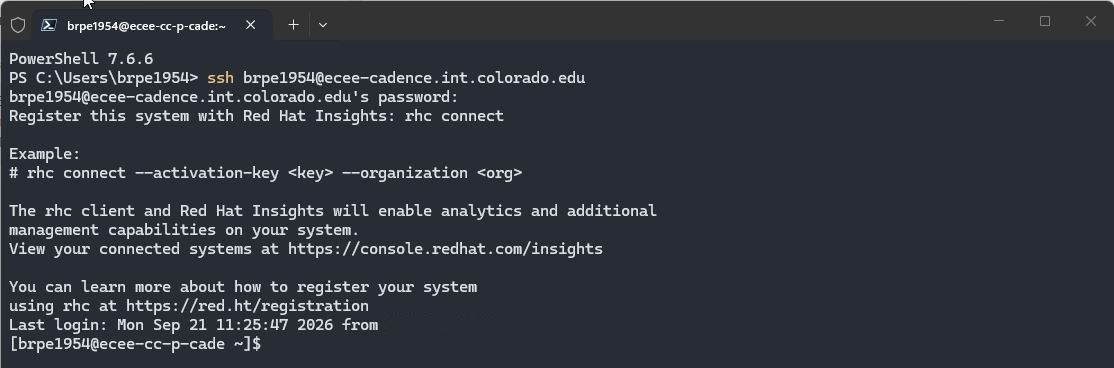
You're logged in when you get a prompt that looks like this.
Now, on the Cadence server run this custom command:
ecee-whats-my-vnc
This tells you everything you need: your display number, your port, and the exact tunnel command for your account.
Write down the port number it gives you. In the screenshot above it's 5902, but yours will be different, that number is specific to you. Now, exit and close this SSH connection. We need to open a new SSH tunnel with port forwarding.
First time logging in? If the command tells you that you don't have a display yet, that can happen sometimes. The server sets up your remote desktop within about half an hour of your access being approved. If it still doesn't work after an hour, email itlpithelp@colorado.edu.
3. Open the SSH tunnel
The Cadence server doesn't accept unencrypted VNC connections from the network. The only way in is through an SSH tunnel (or HTTPS), which is what's protecting your whole session. Now, open a new SSH tunnel that forwards your remote desktop's port number back to your localhost, putting your own port number in both places:
ssh -L 59XX:localhost:59XX identikey@ecee-cadence.int.colorado.edu
The tunnel command. Port 5902 is used in this example, but you'll substitute with whatever ecee-whats-my-vnc told you.
Enter your password and you'll land at a shell prompt again. That's what you want.
Leave this window open. That shell is the tunnel. If you close the shell, the tunnel drops and your VNC window will disconnect. Minimize it, move it off to the side, but don't close it.
4. Point TigerVNC at the tunnel
Launch TigerVNC. In the VNC server box, type localhost:: followed by your port number. And before you click Connect, consider clicking Options... for some additional settings.

The TigerVNC client.
Input: on a laptop trackpad, turn on Emulate middle mouse button. Clicking left and right together then counts as a middle-click, which Virtuoso uses for its popup menu. Leave the clipboard boxes checked.

The Input tab.
Keyboard shortcuts: in full screen, every key goes to the remote desktop. Here are shortcuts to get back out.

The Keyboard shortcuts tab.
The two to remember. Ctrl+Alt+Enter toggles full screen. Ctrl+Alt+M opens the TigerVNC menu while you're connected.
Display: configure full screen for one or multiple monitors.

The Display tab.
Click OK, then Connect.
5. Sign in

Your identikey username and password go here.
About that red "This connection is not secure" banner. Please disregard it. Your connection is encrypted. That warning is about the VNC layer not having a certificate of its own to prove its identity. It doesn't need one: you're already inside the SSH tunnel you opened in the previous step, and SSH is doing the encrypting and identity checking.
6. You're in!

Your desktop on the Cadence server.
This is Xfce, a lightweight Linux desktop. The Applications menu is in the top left corner, and there's a dock along the bottom with a terminal, a file manager, and a web browser. Your home directory on the server is yours and it persists i.e. files you leave there will be there next time. But please save a copy of important files in your OneDrive, profiles may be wiped between semesters. You can open the web browser in your Linux desktop and browse to www.onedrive.com for uploads / downloads to your personal cloud storage.
Closing vs. Logging out
It's good to know the difference between closing your VNC window and logging out of it.
| What you do | What happens |
|---|---|
| Close the TigerVNC window (click the X) | Your session keeps running on the server. Applications stay open, design verifications keep going, and when you reconnect later everything is exactly where you left it. |
| Log Out from the Applications menu | Your session ends and everything running in it is closed. You can log back in, but you get a fresh desktop - whatever you had open does not come back. If you know you are done working for the day, go for this option. |
Coming back later
Once you've done the setup once, reconnecting is just two steps:
- Open PowerShell and run your
ssh -Ltunnel command. - Open TigerVNC and connect to
localhost::59XX.
Your port number stays the same, so you can save the tunnel command somewhere handy. TigerVNC will also remember the address in its dropdown, or you can use Save as... in the connection dialog to keep a shortcut on your desktop.
If something ever seems off, log in over plain SSH and run ecee-whats-my-vnc again. It will always be right about your currently assigned port number, and your permissions to access a desktop.
When it doesn't work
| What you're seeing | What to try |
|---|---|
| "Connection refused" in TigerVNC | Usually that means the tunnel isn't up. Check that your ssh -L window is still open and still logged in. Then check you typed two colons in localhost::59XX on the TigerVNC client window, and that the port matches what your ecee-whats-my-vnc output says. |
| "Authentication failed" with a password you know is right | You might be trying to connect to somebody else's port. Each desktop only accepts its own owner, and correct credentials on the wrong port produces the same error message as a wrong password. Re-run ecee-whats-my-vnc and confirm your number. |
| It connects, then the window closes a few seconds after you enter your password | That's probably something on the server side, not you. Email itlpithelp@colorado.edu and we can take a look at it. |
| Your desktop is frozen and won't respond | First try closing the viewer and reconnecting; a dropped connection usually comes back on its own. If it's genuinely stuck, email itlpithelp@colorado.edu and we can restart your desktop session. But be aware that restarting means anything unsaved in that session could be lost, so tell us in your ticket description if you have work in flight. |
| The whole thing worked last week and doesn't now | Check the VPN first if you're off campus, then re-run ecee-whats-my-vnc. If neither explains it, send us the error + screenshot of what you're seeing. |
MacOS TigerVNC Connection Guide
Introduction
Access to the Cadence server gives you your own Linux desktop that lives in our data center instead of on your Mac. You reach it over an encrypted SSH tunnel, and your session keeps running after you disconnect! Start a design verification check, close the window, reconnect from somewhere else, and it's still there exactly the way you left it.
You don't need to install TigerVNC on your computer to use the Cadence server, you can also connect right from your web browser
(see our guide here). But if you want the most complete remote desktop experience, TigerVNC may be worth the extra setup. It gives you full keyboard control, so all keyboard shortcuts can go to the remote desktop instead of your web browser, full screen on multiple monitors, and a smoother copy and paste clipboard between your computer and the remote desktop.
This guide walks through accessing the server from start to finish and provides troubleshooting tips for common issues. The first time takes multiple steps, mostly figuring out what your remote desktop port is for TigerVNC. After that it's two steps and you're in.
Before you start
- You need access to the server. If you are looking to get access, email itlpithelp@colorado.edu. Include information such as the ECEN Course # you are taking that will be using the Cadence Tools. Researchers – please let us know which research lab you are affiliated with.
- You need to be on the campus network, either connected to CU Secure WiFi or connected to the CU VPN.
- You'll use your identikey username and password – the same credentials you use for other services on campus. There's no separate account for this server.
1. Install TigerVNC
Download the macOS viewer from https://tigervnc.org and grab the latest release. It's a .dmg file. Open it and drag the TigerVNC Viewer app into your Applications folder.
macOS might refuse to open it the first time, because it isn't from the App Store. When that happens, go to System Settings → Privacy & Security, scroll down, and click Open Anyway next to the message about TigerVNC. You only have to do this once.
Don't use the Screen Sharing app that comes with macOS. It speaks VNC, but our server asks for a username and a password, and Apple's client doesn't know how to send both. It will look like your password is wrong when it isn't. Use TigerVNC.
2. Find out which display is yours
Every person on the server gets their own desktop on their own port, so the first thing to do is find out which one is yours. Open a Terminal and log in:
ssh identikey@ecee-cadence.int.colorado.eduThe very first time you connect it'll ask whether you trust the host. Type yes and press Return. Then enter your identikey password.
Now, on the Cadence server run this custom command:
ecee-whats-my-vnc
This tells you everything you need: your display number, your port, and the exact tunnel command for your account. (Screenshot taken on Windows; the output is identical from a Mac.)
Write down the port number it gives you. In the screenshot above it's 5902, but yours will be different, that number is specific to you. Now, exit and close this SSH connection. We need to open a new SSH tunnel that has port forwarding.
First time logging in? If the command tells you that you don't have a display yet, that can happen sometimes. The server sets up your remote desktop within about half an hour of your access being approved. If it still doesn't work after an hour, email itlpithelp@colorado.edu.
3. Open the SSH tunnel
The Cadence server doesn't accept unencrypted VNC connections from the network. The only way in is through an SSH tunnel (or HTTPS), which is what's protecting your whole session. Now, open a new SSH tunnel that forwards your remote desktop's port number back to your localhost. Open a new Terminal window or tab (⌘-N) and run this, putting your own port number in both places:
ssh -L 59XX:localhost:59XX identikey@ecee-cadence.int.colorado.edu
The tunnel command. Port 5902 is used in this example, but you'll substitute with whatever ecee-whats-my-vnc told you.
Enter your password and you'll land at a shell prompt again. That's what you want.
Leave this window open. That shell is the tunnel. If you close the shell, or let your Mac go to sleep, the tunnel drops and your VNC window will disconnect. Minimize it, move it off to the side, but don't close it.
4. Point TigerVNC at the tunnel
Launch TigerVNC Viewer. In the VNC server box, type localhost:: followed by your port number. And before you click Connect, consider clicking Options... for some additional settings.
The TigerVNC client. Yours will have Mac window buttons instead of Windows ones, but it's the same box and the same field.
Input: on a laptop trackpad, turn on Emulate middle mouse button. Clicking left and right together then counts as a middle-click, which Virtuoso uses for its popup menu. Leave the clipboard boxes checked.
The Input tab. (Screenshots taken on Windows.)
Keyboard shortcuts: in full screen, every key goes to the remote desktop. Here are shortcuts to get back out.
The Keyboard shortcuts tab.
The two to remember. Ctrl+Alt+Enter toggles full screen. Ctrl+Alt+M opens the TigerVNC menu while you're connected.
Display: configure full screen for one or multiple monitors.
The Display tab.
Click OK, then Connect.
5. Sign in
Your identikey username and password go here.
About that red "This connection is not secure" banner. Please disregard it. Your connection is encrypted. That warning is about the VNC layer not having a certificate of its own to prove its identity. It doesn't need one: you're already inside the SSH tunnel you opened in the previous step, and SSH is doing the encrypting and identity checking.
6. You're in!
Your desktop on the Cadence server.
This is Xfce, a lightweight Linux desktop. The Applications menu is in the top left corner, and there's a dock along the bottom with a terminal, a file manager, and a web browser. Your home directory on the server is yours and it persists i.e. files you leave there will be there next time. But please save a copy of important files in your OneDrive, profiles may be wiped between semesters. You can open the web browser in your Linux desktop and browse to www.onedrive.com for uploads / downloads to your personal cloud storage.
A note on keys. This is a Linux desktop inside a Mac window, so copy and paste inside the remote desktop is Ctrl-C / Ctrl-V, not ⌘-C / ⌘-V. TigerVNC's Options menu has settings for how the ⌘ and Option keys get passed through.
Closing vs. Logging out
It's good to know the difference between closing your VNC window and logging out of it.
| What you do | What happens |
|---|---|
| Close the TigerVNC window | Your session keeps running on the server. Applications stay open, design verifications keep going, and when you reconnect later everything is exactly where you left it. |
| Log Out from the Applications menu | Your session ends and everything running in it is closed. You can log back in, but you get a fresh desktop - whatever you had open does not come back. If you know you are done working for the day, go for this option. |
Coming back later
Once you've done the setup once, reconnecting is just two steps:
- Open Terminal and run your
ssh -Ltunnel command. - Open TigerVNC and connect to
localhost::59xx.
Your port number stays the same, so you can save the tunnel command somewhere handy. If you'd rather not retype it every time, you may consider adding this to ~/.ssh/config:
Host cadence
    HostName ecee-cadence.int.colorado.edu
    User identikey
    LocalForward 59XX localhost:59XX
Then opening the tunnel is just ssh cadence.
If something ever seems off, log in over plain SSH and run ecee-whats-my-vnc again. It will always be right about your currently assigned port number, and your permissions to access a desktop.
When it doesn't work
| What you're seeing | What to try |
|---|---|
| "Connection refused" in TigerVNC | Usually that means the tunnel isn't up. Check that your ssh -L window is still open and still logged in. Then check you typed two colons in localhost::59XX on the TigerVNC client window, and that the port matches what your ecee-whats-my-vnc output says. |
| "Authentication failed" with a password you know is right | You might be trying to connect to somebody else's port. Each desktop only accepts its own owner, and correct credentials on the wrong port prodcues the same error message as a wrong password. Re-run ecee-whats-my-vnc and confirm your number. |
| macOS won't let you open TigerVNC | System Settings → Privacy & Security → Open Anyway. Once only. |
| It connects, then the window closes a few seconds after you enter your password | That's probably something on the server side, not you. Email itlpithelp@colorado.edu and we can take a look at it. |
| Your desktop is frozen and won't respond | First try closing the viewer and reconnecting; a dropped connection usually comes back on its own. If it's genuinely stuck, email itlpithelp@colorado.edu and we can restart your desktop session. But be aware that restarting means anything unsaved in that session could be lost, so tell us in your ticket description if you have work in flight. |
| The whole thing worked last week and doesn't now | Check the VPN first if you're off campus, then re-run ecee-whats-my-vnc. If neither explains it, send us the error + screenshot of what you're seeing. |
Linux TigerVNC Connection Guide
Introduction
Access to the Cadence server gives you your own Linux desktop that lives on a machine in our data center instead of on your workstation. You reach it over an encrypted SSH tunnel, and your session keeps running after you disconnect! Start a design verification check, close the window, reconnect from somewhere else, and it's still there exactly the way you left it.
You don't need to install TigerVNC on your computer to use the Cadence server, you can also connect right from your web browser
(see our guide here). But if you want the most complete remote desktop experience, TigerVNC may be worth the extra setup. It gives you full keyboard control, so all keyboard shortcuts can go to the remote desktop instead of your web browser, full screen on multiple monitors, and a smoother copy and paste clipboard between your computer and the remote desktop.
This guide walks through accessing the server from start to finish and provides troubleshooting tips for common issues. The first time takes multiple steps, mostly figuring out what your remote desktop port is for TigerVNC. After that it's two steps and you're in.
Before you start
- You need access to the server. If you are looking to get access, email itlpithelp@colorado.edu. Include information such as the ECEN Course # you are taking that will be using the Cadence Tools. Researchers – please let us know which research lab you are affiliated with.
- You need to be on the campus network, either connected to CU Secure WiFi or connected to the CU VPN.
- You'll use your identikey username and password – the same credentials you use for other services on campus. There's no separate account for this server.
1. Install a VNC viewer
Use TigerVNC's viewer, it's in almost every distribution's repository:
# RHEL / Rocky / Alma / Fedora
sudo dnf install tigervnc

# Debian / Ubuntu / Pop!_OS
sudo apt install tigervnc-viewer

# Arch
sudo pacman -S tigervnc
That gives you the vncviewer command and, on most desktops, a "TigerVNC Viewer" entry in your applications menu.
2. Find out which display is yours
Every person on the server gets their own desktop on their own port, so the first thing to do is find out which one is yours. Open a command terminal, log in:
ssh identikey@ecee-cadence.int.colorado.eduThe very first time you connect it'll ask whether you trust the host. Type yes and press Enter. Then enter your identikey password.
Now, on the Cadence server run this custom command:
ecee-whats-my-vnc
This tells you everything you need: your display number, your port, and the exact tunnel command for your account.
Write down the port number it gives you. In the screenshot above it's 5902, but yours will be different, that number is specific to you. Exit and close this SSH connection. We need to open a new SSH tunnel with port forwarding.
First time logging in? If the command tells you that you don't have a display yet, that can happen sometimes. The server sets up your remote desktop within about half an hour of your access being approved. If it still doesn't work after an hour, email itlpithelp@colorado.edu.
3. Open the SSH tunnel
The Cadence server doesn't accept unencrypted VNC connections from the network. The only way in is through an SSH tunnel (or HTTPS), which is what's protecting your whole session. Now, open a new SSH tunnel that forwards your remote desktop's port number back to your localhost, putting your own port number in both places:
ssh -L 59XX:localhost:59XX identikey@ecee-cadence.int.colorado.edu
The tunnel command. Port 5902 is used in this example, but you'll substitute with whatever ecee-whats-my-vnc told you.
Enter your password and you'll land at a shell prompt again. That's what you want.
Leave this session open. That shell is the tunnel — close it and your VNC window disconnects.
4. Point the viewer at the tunnel
From a terminal:
vncviewer localhost::59XXOr launch TigerVNC Viewer from your applications menu and type the same thing in the VNC server box. And before you click Connect, consider clicking Options... for some additional settings. (Started it with vncviewer instead? Press Ctrl+Alt+M once connected and choose Options from there.)
The TigerVNC client. Your window GUI will look like whatever your desktop uses, but it's the same box and the same field.
Input: on a laptop trackpad, turn on Emulate middle mouse button. Clicking left and right together then counts as a middle-click, which Virtuoso uses for its popup menu. Leave the clipboard boxes checked.
The Input tab. (Screenshots taken on Windows.)
Keyboard shortcuts: in full screen, every key goes to the remote desktop. Here are shortcuts to get back out.
The Keyboard shortcuts tab.
The two to remember. Ctrl+Alt+Enter toggles full screen. Ctrl+Alt+M opens the TigerVNC menu while you're connected.
Display: configure full screen for one or multiple monitors.
The Display tab.
Click OK, then Connect.
5. Sign in
Your identikey username and password go here.
Enter your identikey username and password.
About that red "This connection is not secure" banner. Please disregard it. Your connection is encrypted. That warning is about the VNC layer not having a certificate of its own to prove its identity. It doesn't need one: you're already inside the SSH tunnel you opened in the previous step, and SSH is doing the encrypting and identity checking.
6. You're in!
Your desktop on the Cadence server.
This is Xfce, a lightweight Linux desktop. The Applications menu is in the top left corner, and there's a dock along the bottom with a terminal, a file manager, and a web browser. Your home directory on the server is yours and it persists i.e. files you leave there will be there next time. But please save a copy of important files in your OneDrive, profiles may be wiped between semesters. You can open the web browser in your Linux desktop and browse to www.onedrive.com for uploads / downloads to your personal cloud storage.
Closing vs. Logging out
It's good to know the difference between closing your VNC window and logging out of it.
| What you do | What happens |
|---|---|
| Close the viewer window | Your session keeps running on the server. Applications stay open, design verifications keep going, and when you reconnect later everything is exactly where you left it. |
| Log Out from the Applications menu | Your session ends and everything running in it is closed. You can log back in, but you get a fresh desktop - whatever you had open does not come back. If you know you are done working for the day, go for this option. |
Coming back later
Once you've done the setup once, reconnecting is a tunnel and a viewer. Your port number stays the same, so you may consider adding this to ~/.ssh/config:
Host cadence
    HostName ecee-cadence.int.colorado.edu
    User identikey
    LocalForward 59XX localhost:59XX
Then reconnecting is just ssh cadence followed by vncviewer localhost::59XX in a separate terminal.
If something ever seems off, log in over plain SSH and run ecee-whats-my-vnc again. It will always be right about your currently assigned port number, and your permissions to access a desktop.
When it doesn't work
| What you're seeing | What to try |
|---|---|
| "Connection refused" | Usually that means the tunnel isn't up. Confirm it with ss -tlnp | grep 59XX — you should see something listening on 127.0.0.1. Then check you typed two colons in your vncviewer localhost::59XX connection, and that the port matches what your ecee-whats-my-vnc output says. |
| SSH says the local port is already in use | You may have an old backgrounded tunnel still running. pkill -f 59XX:localhost and start fresh. |
| "Authentication failed" with a password you know is right | You might be trying to connect to somebody else's port. Each desktop only accepts its own owner, and correct credentials on the wrong port look exactly like a wrong password. Re-run ecee-whats-my-vnc and confirm your number. |
| It connects, then the window closes a few seconds after you enter your password | That's probably something on the server side, not you. Email itlpithelp@colorado.edu and we can take a look at it. |
| Your desktop is frozen and won't respond | First try closing the viewer and reconnecting; a dropped connection usually comes back on its own. If it's genuinely stuck, email itlpithelp@colorado.edu and we can restart your desktop session. But be aware that restarting means anything unsaved in that session could be lost, so tell us in your ticket description if you have work in flight. |
| The whole thing worked last week and doesn't now | Check the VPN first if you're off campus, then re-run ecee-whats-my-vnc. If neither explains it, send us the error + a screenshot of what you're seeing. |
Starting Cadence Virtuoso
Introduction
Once you're connected to the Cadence server, you have your own Linux desktop with Cadence Virtuoso ready to go. This guide picks up where the connection guides leave off. It covers starting Virtuoso, finding your libraries, creating your own library, running a first simulation, and what to do when something doesn't look right.
If you're not connected yet, start with the Web Browser Connection Guide, or the TigerVNC guide for Windows, macOS or Linux.
Instructions
1. Open a terminal
Click the terminal icon in the dock at the bottom of the screen, or go to Applications → Terminal Emulator. A new terminal starts in your home directory, which is where you want to be.

The terminal icon in the dock.
2. Start Virtuoso
In the terminal, type:
cad-virt.shThe terminal prints a few lines while it sets up the Cadence tools and checks out a license, then the Virtuoso main window opens. This window is called the CIW (Command Interpreter Window). It shows messages from Virtuoso, and every other Virtuoso tool is opened from its menus.
Leave the terminal open. Virtuoso runs from that terminal, and closing it can close Virtuoso along with anything you haven't saved. Minimize it or move it aside instead.
Start from your home directory. Virtuoso reads your settings and library list from the folder it was started in, and saves new libraries and log files there. A new terminal already opens in your home directory. Starting Virtuoso from a different folder can make your libraries seem to disappear.
3. Open the Library Manager
In the CIW, go to Tools → Library Manager. The left column lists every library available to you. You'll see a few standard libraries that everyone gets, such as analogLib (sources, passives and other basic analog parts) and basic. Any libraries you create will show up here too.

The Library Manager. Libraries on the left, then cells and views.
4. Create your own library
Keep your designs in a library of your own. In the Library Manager, go to File → New → Library, give it a name, and click OK. If Virtuoso asks about a technology library, use the one your course or lab tells you to use.
Your new library is created in your home directory and added to your personal library list automatically. It will be there the next time you start Virtuoso.

Creating a new library.
To start a schematic, select your library, then File → New → Cell View, give the cell a name and choose the schematic view type.
5. Run a simulation
From an open schematic, go to Launch → ADE Explorer to set up and run simulations with Spectre.
Tick Plot. One thing catches almost everyone the first time: in the Outputs table, make sure the Plot box is ticked for each signal you want to see. If it isn't, the simulation runs fine but no waveform appears.
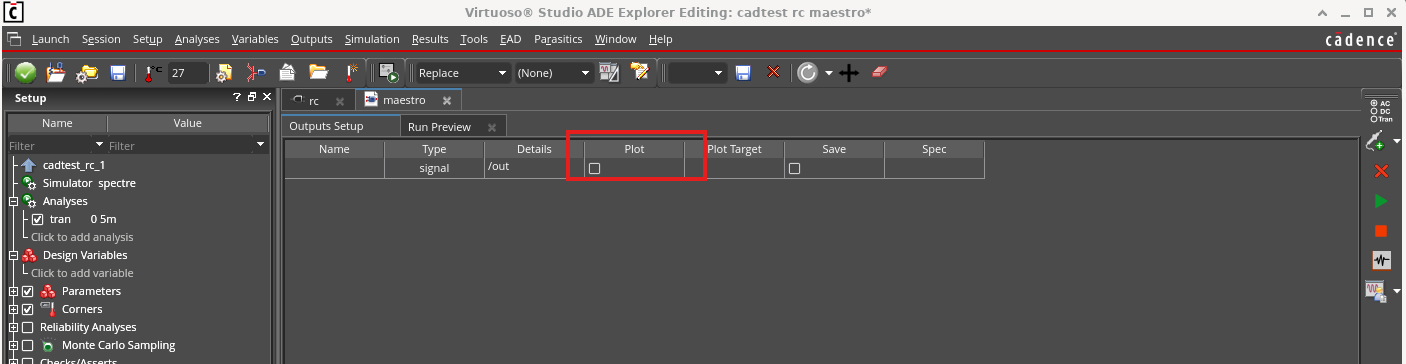
The Plot column in the Outputs table. Tick the box for each output you want to see.

Your first waveform.
Adding your own libraries and design kits
The standard libraries are a baseline for everyone. If your course or research group uses additional libraries or a design kit (PDK), you add them to your own library list. It only affects your account.
- In the CIW, go to Tools → Library Path Editor.
- Edit → Add Library, then point it at the library's folder. If the folder is a valid library, it shows up in the right pane.
- Click OK, then File → Save. If you don't save, the library won't be there next time.
- Open Tools → Library Manager. Your library should now be in the left column.
Only add what you need. Add the libraries your course or research lab tells you to use. Mixing libraries from different design kits in your library list can cause unexpected errors in your designs.
Saving your work and finishing up
- Save often. File → Save in each editor window.
- When you're done, exit Virtuoso with File → Exit in the CIW, then log out from the Applications menu. Closing the browser tab or the VNC window instead leaves your session, and Virtuoso, running.
- Weekly restart. The server restarts every Monday at 4:00 AM for maintenance. Anything unsaved at that time is lost.
- Keep backups. Your home directory persists, but please keep copies of important work in your OneDrive.
When it doesn't work
| What you're seeing | What to try |
|---|---|
cad-virt.sh: command not found |
Open a new terminal and try again. If it still isn't found, log out from the Applications menu and back in. You can also run it by its full path: /usr/cad_tools/cadence/cadscripts/cad-virt.sh |
The Library Manager doesn't show analogLib or the other standard libraries, or you get a "Problem with cds.lib file" message |
Make sure you started Virtuoso from your home directory (type cd ~ first, then cad-virt.sh). Then check that the first line of ~/cds.lib reads SOFTINCLUDE /usr/cad_tools/cadence/setup/cds.lib |
A red ERROR (LMF-02005) about Virtuoso_Schematic_Editor_L when you save a schematic |
Expected, and your schematic still saved. Click Always in the Next License window that follows. See step 4. |
| Virtuoso disappeared | The terminal you started it from was probably closed. Start it again from a new terminal and leave that one open. |
| The simulation finished but no waveform appeared | Tick Plot for your outputs in ADE Explorer and run it again. |
| Virtuoso or ADE hangs while opening a design | Email itlpithelp@colorado.edu with your identikey and the name of the library and cell. Don't keep force-quitting, as it can leave lock files behind. |
Getting help
- For problems with your account, the server or starting Virtuoso, email itlpithelp@colorado.edu. A screenshot of what you're seeing helps a lot.
- For help with design and simulation in Virtuoso, please ask your instructor or research advisor.
- Cadence's own manuals are also on the server. Open the web browser in your Linux desktop and go to
file:///usr/cad_tools/cadence/installs/IC25_1_ISR8_24/doc/